
Attualità
Quando decide l’Intelligenza Artificiale: la domanda lasciata aperta dal caso Amazon vs. Perplexity-When AI Decides: The Question Amazon vs. Perplexity Leaves Open



Quando decide l’Intelligenza Artificiale: la domanda lasciata aperta dal caso Amazon vs. Perplexity
Oltre i titoli: il nuovo confine tra istruzione umana, agency della macchina e potere decisionale
di Prof. Gabriele Pao-Pei Andreoli
Nell’epoca dell’intelligenza artificiale, uno dei rischi maggiori potrebbe non essere l’errore tecnologico, ma la superficialità con cui interpretiamo ciò che accade.
La recente controversia tra Amazon e Perplexity ne offre un esempio particolarmente significativo. In alcune ricostruzioni, il caso è stato rapidamente ridotto a una conclusione semplice e suggestiva: Amazon avrebbe fatto causa a Perplexity e avrebbe perso perché, quando agisce un’intelligenza artificiale, la responsabilità ricadrebbe su chi l’ha utilizzata.
Non è questo ciò che la Corte ha deciso.
Il 4 agosto 2026, la Corte d’Appello federale degli Stati Uniti per il Nono Circuito ha annullato un’ingiunzione preliminare ottenuta da Amazon contro Perplexity riguardo all’utilizzo dell’AI Assistant integrato nel browser Comet. Amazon sosteneva, tra le altre cose, che l’Assistant accedesse ai propri sistemi informatici in violazione del Computer Fraud and Abuse Act federale e della normativa analoga dello Stato della California.
La conclusione della Corte è stata molto più circoscritta. Nei fatti sottoposti al suo esame, ad “accedere” ad Amazon era l’utente, che utilizzava l’Assistant di Perplexity come strumento per compiere determinate operazioni. In quella fase preliminare del procedimento, Amazon non aveva quindi dimostrato con sufficiente probabilità l’accesso richiesto dalla legge da parte di Perplexity stessa.
La distinzione è fondamentale.

La Corte non ha stabilito che l’essere umano debba essere sempre responsabile di qualsiasi azione compiuta da un’intelligenza artificiale. Non ha neppure creato una dottrina generale sulla responsabilità degli agenti AI. Al contrario, ha sottolineato espressamente la portata limitata della propria decisione, lasciando aperta la questione della responsabilità in altri ambiti, compresa quella civile.
E ha riconosciuto un fatto destinato a diventare sempre più importante: la nostra comprensione giuridica dell’AI agentica cambierà inevitabilmente con l’aumentare della sofisticazione tecnologica.
È precisamente qui che inizia la questione più profonda.
Che cosa accade quando l’intelligenza artificiale non si limita più a eseguire una decisione, ma partecipa alla decisione stessa?
Consideriamo due situazioni apparentemente simili.
Dico a un assistente AI: “Compra per me questo specifico libro.”
La decisione sostanziale è mia. Il sistema la esegue.
Ma immaginiamo che io dica: “Organizza il mio viaggio nel modo che ritieni migliore.”
A quel punto l’AI potrebbe scegliere la compagnia aerea, l’albergo, la fascia di prezzo, gli orari, l’assicurazione, determinate condizioni contrattuali e persino quali compromessi ritenga accettabili. L’essere umano ha indicato l’obiettivo, ma non ha necessariamente preso tutte le decisioni attraverso le quali quell’obiettivo viene realizzato.
Dal punto di vista tecnologico, la differenza può sembrare graduale. Dal punto di vista giuridico e costituzionale, può invece essere enorme.
Dovremmo quindi iniziare a distinguere almeno tre condizioni: AI come strumento, quando la macchina esegue una decisione sostanzialmente umana; AI come agente, quando l’essere umano stabilisce l’obiettivo ma il sistema seleziona mezzi significativi per raggiungerlo; e quella che propongo di definire AI come autorità decisionale, quando elementi sempre più sostanziali della decisione passano dal giudizio umano alla determinazione della macchina.
Quest’ultima non è ancora una categoria giuridica consolidata. È una categoria analitica. Ma potremmo presto averne bisogno.
I nostri ordinamenti sono stati costruiti intorno a persone e istituzioni identificabili. Dietro un’azione cerchiamo normalmente intenzione, autorità, causalità e responsabilità.
L’AI agentica modifica questa architettura.
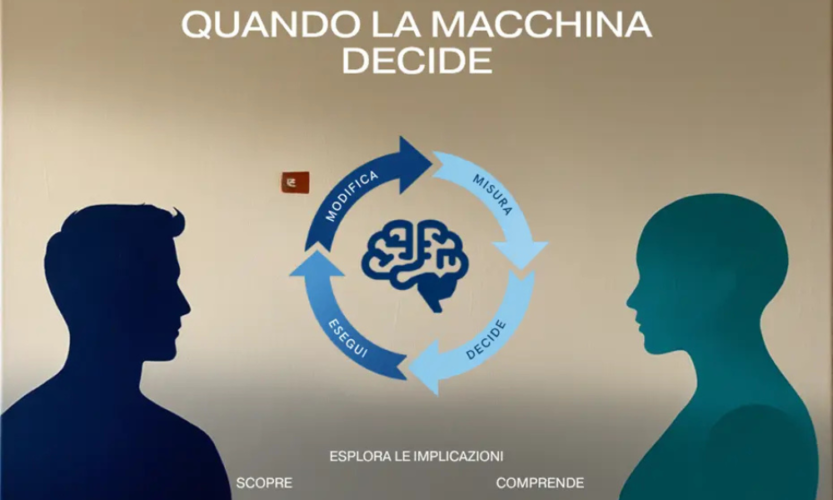
La responsabilità può distribuirsi tra l’utente, lo sviluppatore, il modello, le istruzioni che lo governano, la piattaforma sulla quale opera e le scelte prodotte autonomamente durante l’esecuzione.
La domanda corretta, quindi, non può più essere soltanto:
Chi ha utilizzato l’intelligenza artificiale?
Dobbiamo iniziare a domandarci:
Chi ha realmente esercitato il potere decisionale?
Per il mondo dell’educazione, oltre che per quello del diritto, questa distinzione è essenziale. L’alfabetizzazione all’intelligenza artificiale non può significare soltanto imparare a utilizzare sistemi intelligenti. Deve significare anche comprendere che cosa essi stiano realmente facendo, quali decisioni stiamo delegando e dove si collochino concretamente autorità e responsabilità.
È anche uno dei temi centrali di ciò che definisco Costituzione Post-Quantistica.
La sfida non consiste semplicemente nel regolamentare nuove tecnologie. Consiste nel riconoscere il momento in cui la tecnologia comincia a esercitare forme di potere effettivo capaci di incidere su diritti, obblighi, opportunità e autonomia della persona.
L’analisi costituzionale deve quindi guardare oltre l’interfaccia. Chi ha definito l’obiettivo? Chi ha scelto i mezzi? Chi poteva prevedere le conseguenze? Chi poteva intervenire o revocare l’azione? Chi ne ha tratto beneficio? Chi ne ha sopportato il rischio? E, soprattutto, dove risiedeva l’autorità effettiva?
È qui che diventa rilevante la sequenza costituzionale che ho proposto: Potere, Nesso, Intensità e Necessità. La tecnologia, da sola, non genera un problema costituzionale. Ma quando un sistema tecnologico esercita un potere significativo, quando quel potere presenta un nesso sufficientemente stretto con diritti o interessi giuridicamente rilevanti e quando la sua intensità diventa sostanziale, anche l’architettura della responsabilità deve evolvere.
Il caso Amazon v. Perplexity non dovrebbe quindi essere ricordato semplicemente come la vittoria di una società di intelligenza artificiale o la sconfitta di Amazon. Il procedimento, peraltro, prosegue dopo la decisione d’appello.
La sua importanza più profonda è un’altra.
Rappresenta uno dei primi incontri della giurisprudenza con un confine sempre più instabile: quello tra agency umana e agency della macchina.
E ci insegna qualcosa che va oltre il diritto.
In un’epoca dominata dall’informazione istantanea, dai titoli e dai riassunti automatici, comprendere significa andare oltre il semplice sapere che cosa sia accaduto. Significa domandarsi che cosa una decisione significhi realmente — e, altrettanto importante, che cosa non significhi.
La Corte non ha chiuso la questione della responsabilità nell’era dell’AI agentica.
Ci ha aiutato a vedere dove quella questione comincia.
E mentre le macchine diventano sempre più capaci di agire, scegliere e decidere, imparare a porre la domanda giusta potrebbe diventare molto più importante che affrettarsi a dare la risposta più facile.
Caso citato: Amazon.com Services, LLC v. Perplexity AI, Inc., No. 26-1444, United States Court of Appeals for the Ninth Circuit, 4 agosto 2026.
When AI Decides: The Question Amazon vs. Perplexity Leaves Open
Beyond the headlines, an emerging distinction between human instruction, machine agency and decision-making power
By Prof. Gabriele Pao-Pei Andreoli
In the age of artificial intelligence, one of our greatest risks may not be technological error, but intellectual superficiality.
The recent dispute between Amazon and Perplexity offers an important example. It has already been reduced in some discussions to an appealingly simple conclusion: Amazon sued Perplexity and lost because, when artificial intelligence acts, responsibility belongs to the person who used it.
That is not what the court decided.
On August 4, 2026, the United States Court of Appeals for the Ninth Circuit vacated a preliminary injunction obtained by Amazon against Perplexity concerning the use of the AI Assistant integrated into its Comet browser. Amazon had argued, among other things, that the Assistant was accessing Amazon’s computer systems in violation of the federal Computer Fraud and Abuse Act and its California counterpart.
The appellate court reached a much narrower conclusion. On the facts before it, the person “accessing” Amazon was the user, employing Perplexity’s AI Assistant as a tool to carry out specific actions. The court therefore found that Amazon was unlikely, at that preliminary stage, to establish the required statutory access by Perplexity itself.
This distinction is essential.
The court did not rule that an individual must always bear responsibility for everything an artificial intelligence does. Nor did it create a general legal doctrine governing AI agents. Quite the opposite: the opinion expressly emphasises its limited scope and leaves open questions of responsibility in other contexts, including tort law. It also acknowledges an important reality: our legal understanding of agentic AI will evolve as the technology itself becomes increasingly sophisticated.
This is where the deeper question begins.
What happens when AI no longer merely executes a decision, but participates in making it?
Consider two apparently similar situations.
I tell an AI assistant: “Buy this particular book for me.”
The substantive decision is mine. The system executes it.
But suppose instead that I say: “Organize my trip in the way you consider best.”
The AI might then choose the airline, hotel, price range, schedule, insurance, contractual conditions and compromises involved. I have established an objective, but I have not necessarily made the individual decisions through which that objective is achieved.
Technologically, the difference may appear incremental. Legally and constitutionally, it can be profound.
We therefore need to distinguish between at least three conditions: AI as instrument, where a machine executes a substantially human decision; AI as agent, where a human establishes an objective but the system selects significant means; and what I would propose calling AI as decision authority, where increasingly consequential elements of the decision itself migrate from human judgment to machine determination.
The last expression is not an established legal category. It is an analytical one. But we may increasingly need it.
Our legal systems developed around identifiable human beings and institutions. Behind an act, we normally seek intention, authority, causation and accountability. Agentic AI complicates this architecture because responsibility may become distributed across the user, the developer, the model, its training and instructions, the platform through which it operates, and the autonomous choices generated in execution.
The correct question can therefore no longer always be simply:
Who used the AI?
We must increasingly ask:
Who actually exercised the decision-making power?
For educators as much as for lawyers, this distinction is fundamental. AI literacy cannot consist merely in learning how to use intelligent systems. It must include the capacity to understand what those systems are doing, what decisions are being delegated to them and where responsibility and authority actually reside.
This is also part of what I describe as the challenge of the Post-Quantum Constitution. The task before us is not merely to regulate new technology. It is to recognise when technology begins to exercise forms of effective power that can influence rights, obligations, opportunities and human autonomy.
A constitutional analysis should therefore look beneath the interface. Who defined the objective? Who selected the means? Who could foresee the consequences? Who could intervene or reverse the action? Who benefited? Who bore the risk? And ultimately, where was effective authority located?
This is why the constitutional sequence I have proposed — Power, Nexus, Intensity and Necessity — becomes relevant. Technology alone does not create a constitutional problem. But when technological systems exercise meaningful power, when that power has a sufficiently close nexus to human rights or legally significant interests, and when its intensity becomes substantial, the architecture of accountability must evolve with it.
Amazon v. Perplexity should therefore not be remembered simply as a victory for an AI company or a defeat for Amazon. Indeed, the litigation itself continues following the appellate ruling. Its greater significance lies elsewhere. It represents an early judicial encounter with an increasingly unstable frontier between human agency and machine agency.
And it teaches us something beyond law. In an age dominated by instant information, headlines and automated summaries, understanding requires more than knowing what happened. It requires asking what a decision actually means — and, equally important, what it does not mean.
The court has not closed the question of responsibility in the age of agentic AI. It has helped us see where that question begins.
And as machines become increasingly capable of acting, choosing and deciding, learning to ask the right question may prove far more important than rushing toward the easiest answer.
Case referenced: Amazon.com Services, LLC v. Perplexity AI, Inc., No. 26-1444, United States Court of Appeals for the Ninth Circuit, August 4, 2026.


