
Italiani nel Mondo
Gli italiani nel mondo: una realtà complessa e non solo una semplice idea. Parte 1- Italians Around the World: A Complex Reality, Not Just a Simple Idea—Part 1



Gli italiani nel mondo: una realtà complessa e non solo una semplice idea, Parte 1
di Gianni Pezzano
In attesa dei risultati delle elezioni dei Comites (Comitati Italiani all’estero, registrati a livello consolare), diamo uno sguardo agli “Italiani nel mondo”, ovvero agli italiani sparsi per il mondo in generale, perché, da quando Mirko Tremaglia ha iniziato la sua battaglia per ottenere una rappresentanza nel Parlamento italiano, il concetto di “Italiani nel mondo” è diventato un’espressione che ad alcuni può sembrare chiara e definita, ma basta poco per capire che la realtà è molto più complessa di quanto l’etichetta lasci intendere.
Partiamo da quella che sembra una semplice domanda: quanti italiani ci sono nel mondo? E per rispondere a questa domanda dobbiamo prima porne un’altra: che cos’è un «italiano»?
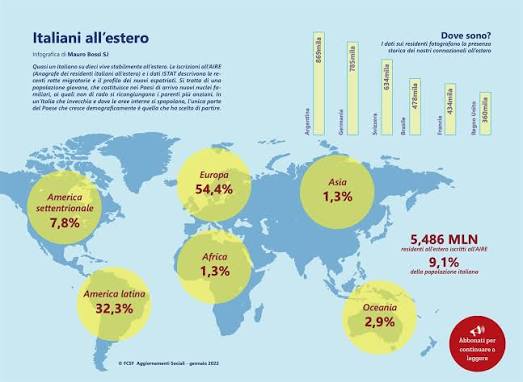
In termini di definizione giuridica e, quindi, di diritto di voto per la rappresentanza al Parlamento italiano e ai Comites, la risposta è semplice: tutti coloro che sono regolarmente iscritti all’A.I.R.E. (Anagrafe degli Italiani Residenti all’Estero) presso i rispettivi consolati locali. In effetti, i cittadini italiani, nati in Italia o in altri paesi, aventi diritto di voto. Una rapida ricerca online mostra che attualmente ci sono circa 6,6 milioni di italiani iscritti all’A.I.R.E., ma non tutti gli italiani che si trasferiscono all’estero si registrano, sebbene sia obbligatorio farlo dopo 6 mesi di residenza in un paese, quindi i numeri reali potrebbero essere più elevati.
È inoltre evidente che l’A.I.R.E. non tiene conto, né può farlo, delle due categorie di italiani all’estero che costituiscono la stragrande maggioranza di coloro che vengono considerati «italiani nel mondo»: (1) i discendenti di migranti italiani che soddisfano i requisiti per la cittadinanza italiana ma non hanno presentato domanda per essere riconosciuti come cittadini, e (2) i discendenti di migranti italiani che non possiedono la cittadinanza italiana, ma che non sono meno italiani dei loro parenti che ancora la possiedono.
Tutto ciò, ovviamente, significa che calcolare il numero reale di italiani nel mondo è praticamente impossibile, ma le stime più autorevoli indicano una cifra di circa 85-90 milioni di persone in tutto il mondo, di cui una percentuale potrebbe benissimo essere costituita da cittadini italiani senza saperlo, pari all’incirca a una volta e mezzo l’attuale popolazione italiana.
Ora, tralasciando gli italiani registrati nell’A.I.R.E., torniamo ancora una volta alla seconda domanda che ci siamo posti: che cos’è un “italiano”?
E, rispondendo a questa domanda, cominciamo davvero a comprendere ancora di più che la realtà degli «italiani nel mondo» è davvero complessa, perché ora dobbiamo porci altre due domande che, per ovvie ragioni, non possono essere eluse:
1) Parlano l’italiano? Potrebbe sembrare una domanda ovvia, ma se consideriamo la migrazione di massa degli italiani prima del 1908, la maggior parte dei migranti parlava dialetto, non l’italiano. Quindi, a casa insegnavano ai propri figli i loro dialetti e NON l’italiano. La situazione era ulteriormente aggravata dal fatto che pochissimi di questi figli/discendenti avevano l’opportunità di imparare l’italiano a scuola. Pertanto, la lingua non può essere l’unico criterio per stabilire se qualcuno sia italiano o di origine italiana.
2) Il loro cognome è italiano? A parte il fatto che molti italiani hanno cognomi non italiani – un esempio è il tennista Jannik Sinner – e che molti svizzeri, francesi e cittadini di altri paesi hanno cognomi italiani, il compito di identificare i discendenti degli italiani è reso più difficile anche dal fatto che in molti altri paesi le donne sposate assumono il cognome del marito e, quando sposano persone non italiane, è impossibile identificare i loro figli come discendenti solo in base al cognome. Pertanto, il cognome di una persona di per sé non è un fattore determinante per stabilire se una persona sia italiana.
Eppure, anche se individuare il numero esatto degli italiani all’estero è estremamente difficile, ciò non cambia il fatto che gli «italiani nel mondo» rappresentino una realtà importante per gli italiani in patria, e non solo perché molti di loro vengono in Italia per le vacanze e/o per riscoprire le proprie origini italiane.
Allora, a parte i Comites, in che modo gli “Italiani nel mondo” interagiscono con gli italiani in Italia e in altri paesi?
Infatti, negli ultimi anni, i social media sono diventati uno strumento potente per riunire gli italiani sparsi in tutto il mondo. Questo dovrebbe essere un aspetto positivo non solo per gli “italiani nel mondo” e per gli italiani che vivono ancora in Italia, ma queste pagine sono diventate campi di battaglia proprio per le ragioni che rendono i loro membri italiani.
Purtroppo, c’è una percentuale di italiani residenti in Italia che si rifiuta di riconoscere gli “italiani nel mondo” come “italiani” perché agiscono in modo diverso da ciò che considerano “italiano”, al punto che alcuni di loro arrivano persino a intervenire sulle pagine dei quotidiani d’estero, in particolare sul “New York Times”, e più specificatamente sulle sue pagine dedicate alla cucina, per affermare che le ricette “non sono italiane”. Ma, comportandosi in questo modo, queste persone spesso dimostrano di essere esse stesse ignoranti riguardo alle tradizioni di altre regioni d’Italia perché, in molti casi, queste persone sconsiderate non si rendono conto che molte delle cose che criticano sono in realtà italiane, poiché gli “italiani nel mondo” hanno mantenuto vive le loro tradizioni familiari nei loro nuovi paesi.
E l’altra questione che va affrontata quando si parla degli “italiani nel mondo” è che, inevitabilmente e naturalmente, le persone che emigrano cambiano nel tempo, per quanto abbiano a cuore le proprie origini e cerchino di mantenere vive le proprie tradizioni. Questo non accade solo con la cucina, come alcuni credono ingenuamente, ma anche con altri aspetti della vita che differiscono da paese a paese. Un esempio è il famoso “mate”, la bevanda a base di erbe che molti italiani in Argentina hanno adottato come parte della loro vita quotidiana.
Tuttavia, tutto ciò non li esclude dall’essere italiani, anche perché l’Italia stessa è cambiata nello stesso arco di tempo, e ne abbiamo avuto un esempio lampante sabato scorso in tutto il Paese, con innumerevoli bambini in costume che andavano di casa in casa per il “Dolcetto o scherzetto”, l’equivalente italiano dell’americano “Trick or treat” per Halloween che è ormai diventato un appuntamento fisso del calendario italiano. Senza dimenticare che le origini di Halloween sono in realtà europee, e che quindi la tradizione è tornata nel continente in cui è nata…
E le ragioni dei cambiamenti in Italia spaziano su innumerevoli aspetti e non si limitano alle serie TV e ai film americani che hanno ispirato i bambini italiani ad adottare Halloween, a partire dalle rivolte del 1968 che hanno portato a enormi cambiamenti nella società italiana.
Esistono quindi molti modi di essere italiani, il che implica necessariamente che dobbiamo essere flessibili nel modo in cui ci rapportiamo con gli “italiani nel mondo”, poiché sono davvero i nostri parenti e amici all’estero e non dovrebbero quindi essere considerati “estranei” da chi vive in Italia, anche perché quegli “estranei” hanno svolto un ruolo fondamentale nello sviluppo dell’Italia in molti modi che troppe persone in Italia hanno dimenticato, a cominciare dalle rimesse che quasi tutti i migranti inviavano alle loro famiglie in Italia e che hanno avuto un ruolo fondamentale nella ricostruzione del Paese dopo la Seconda Guerra Mondiale, cosa che molti in Italia hanno dimenticato, come abbiamo descritto in un articolo precedente
Pertanto, non si dovrebbe essere troppo frettolosi nell’etichettare gli altri come “non veri italiani” e queste divergenze di opinione devono essere messe in discussione, perché gli “italiani nel mondo” non sono solo un’etichetta, ma anche un’enorme risorsa per il Paese che molti qui ancora non comprendono, né apprezzano, e discuteremo di questo tema nel prossimo articolo.
Italians Around the World: A Complex Reality, Not Just a Simple Idea—Part 1
by Ginni Pezzano
As we await the result of the elections of the Comites (Comitati Italiani all’estero / Committees of Italians Resident Abroad, registered at a consular level), let us look at the “Italiani nel mondo”, in other words the Italians around the world in general, because, since Mirko Tremaglia began his battle to gain representation in Italy’s Parliament, the “Italiani nel mondo” has become a concept that may seem clear cut to some, but it does not take much to understand that the reality is much more complex than the label describes.
Let us start with what seems to be a simple question: how many Italians are there around the world? And to answer this question we must first ask another: What is an “Italian”?
In terms of the legal definition and therefore voting for representation in Italy’s Parliament and the Comites, the answer is simple, all those regularly registered in the A.I.R.E. (Anagrafe Italiani Residenti all’Estero / Register of Italians Residing Abroad) at their local consulates. In effect, Italian citizens, whether born in Italy or in other countries, with the right to vote. A quick online research shows that there are currently approximately 6.6 million Italians registered in the A.I.R.E., but not all Italians who move abroad register, although it is compulsory to do so after 6 months residency in a country, so the real numbers may be greater.
It is also obvious that the A.I.R.E. does not and cannot account for the two categories of Italians overseas that make up the vast majority of those considered “Italiani nel mondo”: (1) the descendants of Italian migrants who meet the requirements for Italian citizenship but have not applied for to be recognized as citizens, and (2) the descendants of Italian migrants who do not have Italian citizenship, but who are no less Italian than their relatives who still have it.
All this, of course, means that calculating the real numbers of Italians around the world is practically impossible, but the most authoritative estimates give the numbers at about 85-90 million people around the world, a percentage of which may well be Italian citizens without knowing it, roughly one and a half times the current population of Italy.
Now, setting aside the Italians registered in the A.I.R.E, we return once again to the second question we asked: What is an “Italian”?
And, in answering this question we truly start to understand even more that the reality of the “Italiani nel mondo” really is complex because we must now ask two other questions that, for obvious reasons, cannot be avoided:
-
Do they speak Italian? This may seem an obvious question, but if we consider the mass migration of Italian before the 1908s, most of the migrants spoke dialect, not Italian. So, if they taught their dialects to their children at home and NOT Italian. This was made even worse by the fact that very few of these children/descendants had the opportunity to learn Italian at school. So, the language cannot be the sole reason to decide whether someone is Italian or of Italian origin.
-
Is their surname Italian? Aside from the fact that many Italian have non-Italian surnames, one example is the tennis player Jannik Singer, and that many Swiss, French and other countries have Italian surnames, making the task of identifying descendants of Italians is made harder also by the fact that in many other countries married women take the surname of their husbands and when they marry non-Italians it is impossible for their children to be identified as descendants by their surname alone. So, the surname of a person on its own is not a deciding factor for deciding whether a person is Italian.
And yet, even though identifying the precise numbers of Italians abroad is extremely difficult, this does not change the fact that the “Italiani nel mondo” are an important reality for Italians, and not simply because many of them come to Italy for their holidays and/or to find their Italian origins.
So, aside from the Comites, how do the “Italiani nel mondo” interact with Italians in Italy and other countries?
In fact, in recent years, the social media has become a powerful tool for bringing together Italians around the world. This should be a positive aspect regarding not just the “Italiani nel mondo” and the Italians still in Italy, but these pages have become battlegrounds for the precise reasons that make them members of the pages Italian.
Sadly, there is a percentage of Italians of Italy who refuse to recognize the “Italiani nel mondo” as “Italians” because they do things differently than what they consider “Italian”, to the point that some of them even go onto the pages of overseas newspapers, particularly “The New York Times”, specifically its cooking pages, to say that recipes are “not Italian”. But, in acting in this way, these people often show that they themselves are ignorant of the traditions of other regions in Italy because, in many cases, these inconsiderate people do not realize that many of the things they criticize really are Italian because the “Italiani nel mondo” had kept their family traditions alive in their new countries.
And the other issue that must be faced when talking about the “Italiani nel mondo” is that, inevitably and naturally, people who migrate change over time, no matter how much they cherish their origins and try to keep their traditions live. This does not happen just with cooking, as some people naively believe, but also with other aspects of life that differ from country to country. One such example is the famous “mate”, the herbal beverage that many Italians in Argentina have adopted as part of their daily lives.
Yet, all this does not disqualify them from being Italian, also because Italy itself has changed over the same period of time, and we had a notable example of this last Saturday evening around the country with countless children in costumes going from house to house for “Dolcetto o scherzetto”, the Italian equivalent of the American “Trick or treat” for Halloween that has become a fixed part of Italy’s calendar. Without forgetting that the origins of Halloween were in fact European, and so the tradition has returned to the continent of its creation…
And the reasons for the changes in Italy range over countless issues and not just the American TV shows and films that inspired Italian children to adopt Halloween, starting with the 1968 revolts that led to enormous changes in Italian society.
So, there are many ways of being Italian, which necessarily means that we must be flexible in how we deal with “Italiani nel mondo” because they truly are our relatives and friends overseas and therefore should not be seen as “outsiders” by people in Italy, also because those “outsiders” played a huge role in the development of Italy in many ways that too many people in Italy have forgotten, starting with the remittances almost all the migrants sent back to their families in Italy that played a huge role in Italy’s recovery after the Second World War that many people in Italy have forgotten, as we described in a previous article .
Therefore, people should not be too quick in labelling others as “not real Italians” and these differences of opinion must be challenged because the “Italiani nel mondo” are not just a label, but also an enormous resource for the country that many people here still do not understand, or appreciate, and we will discuss this issue in the next article.


