
Diritti umani
Da Washington al Venezuela, il Prof. Andreoli parla di diplomazia scientifica, diritti umani e responsabilità globale in un momento storico critico- From Washington to Venezuela, Prof. Andreoli discusses scientific diplomacy, human rights, and global responsibility at a critical moment in history


Da Washington al Venezuela, il Prof. Andreoli parla di diplomazia scientifica, diritti umani e responsabilità globale in un momento storico critico
Di Prof. Gabriele Pao-Pei Andreoli – Presidente, Institute for Advanced Studies and Cooperation (IASC) – Membro della Consulta per i Diritti Umani Internazionali dell’Ordinariato Militare del Venezuela, in collaborazione con l’Ufficio Internazionale OO.MM. – Dipartimento dei Diritti Umani
In questo particolare momento storico—segnato da conflitti rinnovati, instabilità geopolitica e da una crescente erosione del rispetto dell’ordine internazionale—parlare di pace non può essere un esercizio formale. Oggi la pace non rappresenta più il quadro stabile entro cui opera la politica; è diventata una condizione fragile, che deve essere consapevolmente tutelata, eticamente governata e istituzionalmente rinnovata.
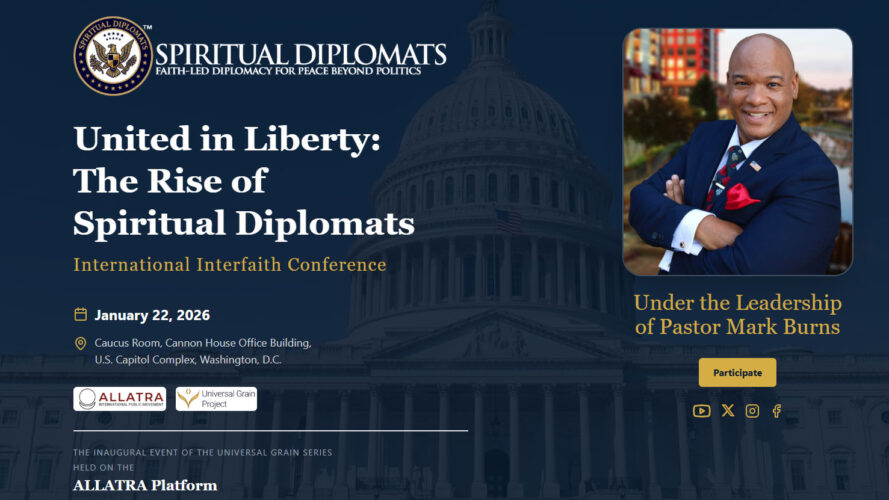
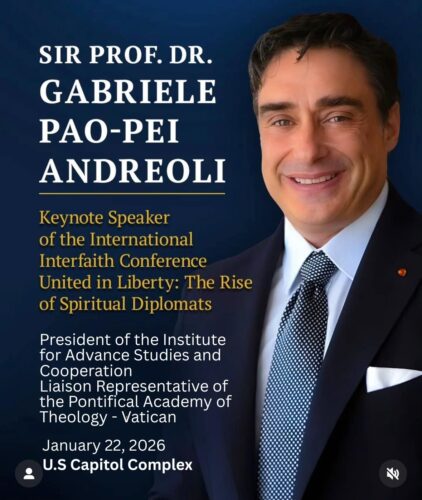
È in questo contesto che mi recherò a Washington, D.C., per partecipare all’incontro dei leader spirituali a Capitol Hill. Questa partecipazione rappresenta per me non solo un onore, ma una profonda responsabilità—accademica, istituzionale e umana.
Anche quest’anno, come in molti precedenti, mi sono trovato di fronte a una scelta consueta: essere presente al World Economic Forum di Davos oppure accogliere l’invito a questo incontro a Washington. Pur riconoscendo il valore di Davos come spazio di confronto su economia, tecnologia e cooperazione globale, questa volta la decisione è stata immediata. In un periodo caratterizzato da crescenti aggressioni e da un indebolimento del rispetto delle norme e dei confini internazionali, mi è parso essenziale essere presente là dove coscienza e istituzioni possono incontrarsi direttamente.
In questa occasione presenterò il lavoro sviluppato insieme al Professor Alberto Contu, dal titolo:
Costituzionalismo globale e tecnologie del potere – Un compendio etico-garantista per la pace mondiale
Ispirato al pensiero etico-costituzionale di Luigi Ferrajoli, questo lavoro muove da una premessa chiara: la pace non è un’astrazione morale né uno slogan politico. È una condizione costituzionale. Senza garanzie effettive, limiti all’arbitrio del potere e responsabilità istituzionale, la pace resta retorica—e i diritti umani rimangono esposti.
Oggi, tuttavia, il potere non si esercita più soltanto attraverso strutture politiche o militari visibili. Agisce sempre più attraverso le tecnologie: intelligenza artificiale, governance algoritmica, infrastrutture dei dati e sistemi computazionali emergenti che influenzano le decisioni ben prima che il diritto possa intervenire. In questo scenario, la diplomazia scientifica diventa essenziale—non come celebrazione dell’innovazione, ma come assunzione di responsabilità nel governare conoscenza e tecnologia come infrastrutture strategiche dei diritti, della dignità e della pace.
La mia presenza a Washington è ulteriormente rafforzata dal mio ruolo di Membro della Consulta per i Diritti Umani Internazionali dell’Ordinariato Militare del Venezuela, in collaborazione con l’Ufficio Internazionale OO.MM. – Dipartimento dei Diritti Umani. Questo incarico mi ricorda costantemente che la pace non è mai teorica. Riguarda la protezione concreta della dignità umana, soprattutto nei contesti segnati da conflitto, militarizzazione e fragilità istituzionale.
Da questa prospettiva, il Venezuela non è soltanto un riferimento geopolitico, ma un luogo di responsabilità. Rappresenta la realtà vissuta di quanto la pace diventi fragile quando le garanzie si indeboliscono, e di quanto sia essenziale che i diritti umani restino ancorati a fondamenti etici e giuridici, piuttosto che a interessi politici contingenti.
In questo contesto, la diplomazia spirituale svolge un ruolo insostituibile. Non come alternativa al diritto o alle istituzioni, né come forma di proselitismo, ma come infrastruttura morale capace di generare fiducia laddove la politica da sola fatica. Leader spirituali, studiosi e rappresentanti istituzionali sono chiamati ad agire insieme proprio negli spazi in cui trattati e politiche risultano insufficienti—riportando la coscienza al centro della governance.
Diplomazia scientifica e diplomazia spirituale, quando operano in modo coordinato, offrono una risposta potente alle sfide del nostro tempo. Ricordano che la tecnologia deve servire l’umanità e non dominarla; che il potere deve essere limitato dall’etica; e che la pace non si fonda soltanto sugli equilibri di forza, ma sulla responsabilità condivisa.
Essere presenti oggi a Capitol Hill non è quindi un gesto simbolico. È una scelta consapevole di contribuire a un dialogo globale in cui diritto, etica, scienza e spiritualità convergono al servizio della pace e dei diritti umani.
Nei tempi dell’incertezza, il silenzio è più facile.
La presenza è una responsabilità.
Ed è una responsabilità che assumo con umiltà, determinazione e speranza.
From Washington to Venezuela, Prof. Andreoli discusses scientific diplomacy, human rights, and global responsibility at a critical moment in history
By Prof. Gabriele Pao-Pei Andreoli – President, Institute for Advanced Studies and Cooperation (IASC) – Member of the Consultative Council for International Human Rights of the Military Ordinariate of Venezuela, in collaboration with the International Office O.O.M.M. – Human Rights Department
At this particular moment in history—marked by renewed conflicts, geopolitical instability, and a growing erosion of respect for international order—the responsibility of speaking about peace cannot be taken lightly. Peace today is no longer a stable framework within which politics operates; it has become a fragile condition that must be consciously protected, ethically governed, and institutionally renewed.
It is within this context that I am travelling to Washington, D.C., to take part in the gathering of spiritual leaders at Capitol Hill. This participation represents for me not only an honour, but a profound responsibility—academic, institutional, and human.
This year, as in many previous ones, I was faced with a familiar choice: to be present at the World Economic Forum in Davos or to join this gathering in Washington. While Davos remains an important space for dialogue on economics, technology, and global cooperation, the decision this time was immediate. In a period marked by increasing aggressions and weakening respect for international norms and boundaries, it felt essential to be present where conscience and institutions meet directly.
On this occasion, I will present the work developed together with Professor Alberto Contu, entitled:
Global Constitutionalism and Technologies of Power – An Ethical-Garantist Compendium for World Peace
Inspired by the ethical-constitutional thought of Luigi Ferrajoli, this work advances a clear premise: peace is not a moral abstraction or a political slogan. It is a constitutional condition. Without enforceable guarantees, limits to arbitrary power, and institutional accountability, peace remains rhetorical—and human rights remain exposed.
Today, however, power no longer operates only through visible political or military structures. It increasingly acts through technologies: artificial intelligence, algorithmic governance, data infrastructures, and emerging computational systems that shape decisions long before the law can intervene. In this context, scientific diplomacy becomes essential—not as a celebration of innovation, but as a responsibility to govern knowledge and technology as strategic infrastructures of rights, dignity, and peace.
My presence in Washington is further shaped by my role as Member of the Consultative Council for International Human Rights of the Military Ordinariate of Venezuela, in collaboration with the International Office O.O.M.M. – Human Rights Department. This mandate constantly reminds me that peace is never theoretical. It concerns the concrete protection of human dignity, particularly in contexts affected by conflict, militarization, and institutional fragility.
From this perspective, Venezuela is not merely a geopolitical reference, but a place of responsibility. It represents the lived reality of how fragile peace becomes when guarantees weaken, and how essential it is that human rights remain anchored in ethical and legal foundations rather than contingent political interests.
Here, spiritual diplomacy plays an irreplaceable role. Not as a substitute for law or institutions, and not as proselytism, but as the moral infrastructure that allows trust to emerge where politics alone struggles. Spiritual leaders, scholars, and institutional representatives are called to act together in those spaces where treaties and policies prove insufficient—bringing conscience back into governance.
Scientific and spiritual diplomacy, when aligned, offer a powerful response to the challenges of our time. They remind us that technology must serve humanity, not dominate it; that power must be restrained by ethics; and that peace is sustained not only by balances of force, but by shared responsibility.
To be present at Capitol Hill today is therefore not symbolic. It is a conscious choice to contribute to a global dialogue in which law, ethics, science, and spirituality converge in service of peace and human rights.
In times of uncertainty, silence is easier.
Presence is a responsibility.
And it is one I carry with humility, determination, and hope.


